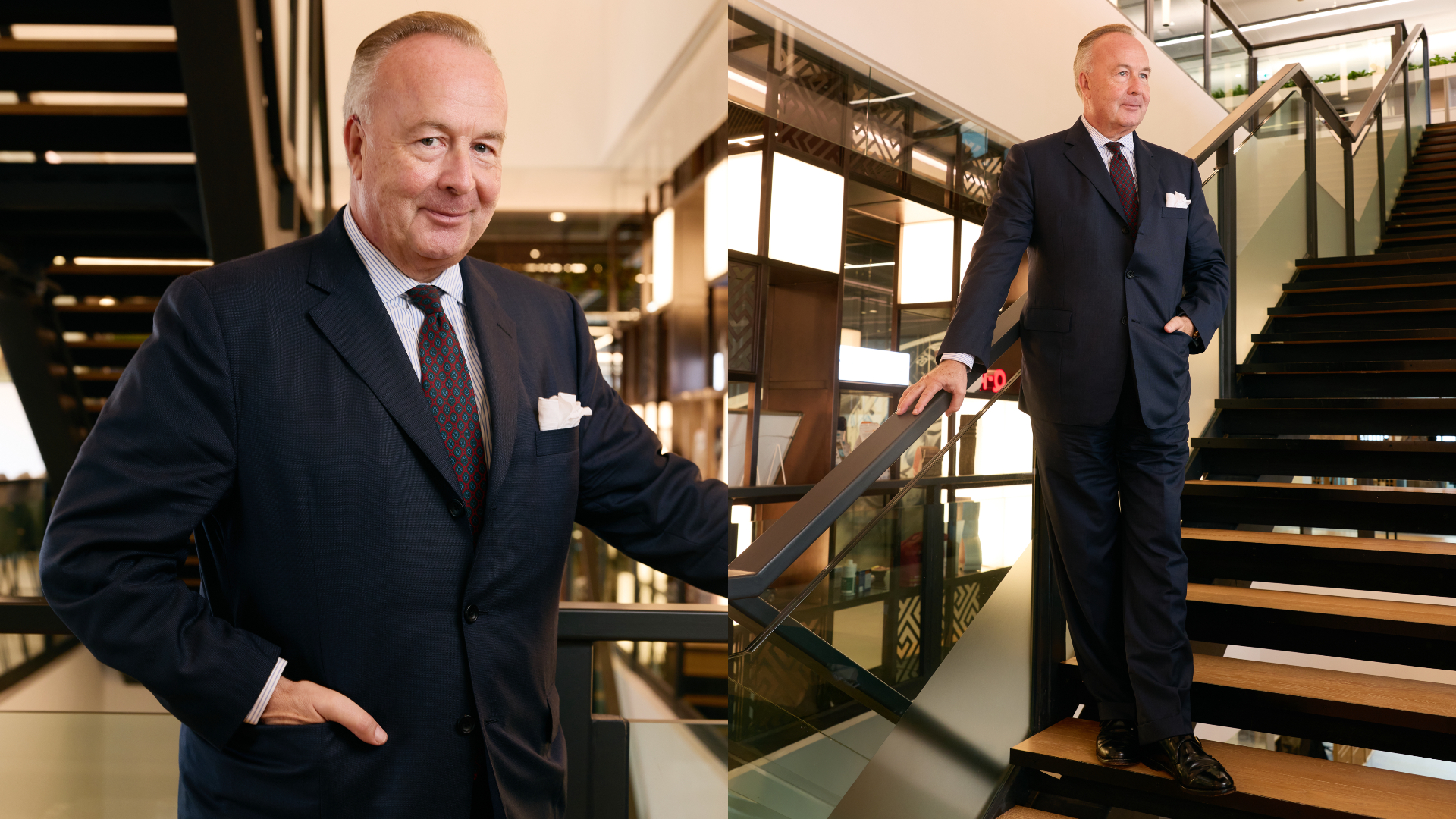
In an era defined by global fractures and relentless technological disruption, how do we safeguard the soul of a city? To mark the 40th anniversary of the Asian Cultural Council (ACC) Hong Kong, we sat down for a warm, reflective afternoon conversation with Hans Michael Jebsen, Chairman of the Jebsen Group and Chair Emeritus of ACC Hong Kong’s Board. He proves that true strength doesn’t require disruption; instead, by championing the arts and the power of listening, he builds enduring bridges in a divided world.

In the lexicon of GQ, we are accustomed to chronicling the sharp, aggressive titans of commerce who are eager to upend markets with disruptive innovation. But when Hans Michael Jebsen, Chairman of the Jebsen Group, and Chair Emeritus of ACC Hong Kong’s Board, having served as its Chairman from 2003 to 2024 sits down with a relaxed smile and notes in his warm baritone that “what we need is goodwill, what we need is people interacting with each other,” you immediately sense this will be a profoundly different kind of conversation.
This unassuming brand of strength perfectly echoes the core ethos of the ACC. Tracing its origins back to the mid-1960s—a turbulent decade defined by Cold War rhetoric and the Vietnam War—the organization was founded by John D. Rockefeller 3rd to carve out a neutral space for dialogue beyond political and economic friction. Carrying the torch for ACC Hong Kong’s 40th anniversary, Jebsen feels this mission deeply. “What we also need is another lens, a different lens than the geopolitical lens,” he explains. For him, this isn’t some abstract ideal, but a tangible antidote. As he succinctly puts it, “Art connects and art is a common language”.
Over the past four decades, the ACC has supported over 6,000 artists and scholars. For Jebsen, these aren’t just cold statistics, but vibrant individuals. The grantees are incredibly diverse, or, as he describes them, “different like chalk and cheese”. From Jaffa Lam, Wucius Wong, and Oscar Ho to Lio Kuokman, these names stand as a testament to the program’s depth and reach. It is a point of immense pride that the Hong Kong chapter is entirely funded by local patrons. “Hong Kong is a place with the most NGOs per capita in the world,” Jebsen notes with a smile, “which doesn’t make it easier to collect money by the way because they’re all chasing for the same dollar. But it’s been very rewarding to see that we have a lot of far-sighted and generous individuals who can see the great wealth that is in the diversity of supporting the arts”. When artists travel abroad, it is about more than just academic learning; it is a journey of self-discovery. After all, “you cut your own profile against something else”.
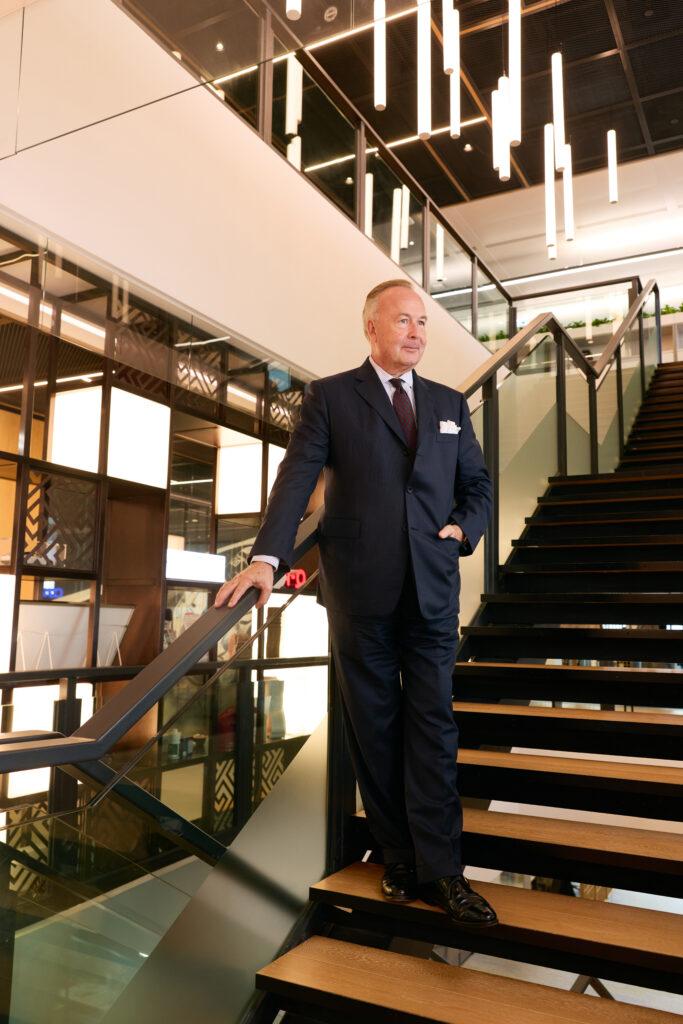
Speaking of Hong Kong’s hyper-dense urban landscape, Jebsen offers unique insights into space and community relations. Extreme urbanization inevitably breeds a sense of alienation, but he borrows an ancient African proverb to make his point: “It takes a village to educate a kid”. Amidst the concrete jungle, arts and cultural facilities are crucial to rebuilding that “village.” We must actively create these communities, he suggests. Whether it is a sprawling cultural district or an independent gallery, these spaces serve as a social adhesive, allowing people from vastly different backgrounds to resonate within the same room.
As technology hurtles forward, we are crossing the threshold from the analog era into an AI-dominated future. Jebsen holds high expectations for the next generation of leaders. Situated within the intellectually vibrant Greater Bay Area, Hong Kong possesses unparalleled momentum. Yet, while pursuing commercial profits, corporate leaders must also shoulder their social responsibilities. “It’s not a luxury,” he says firmly of the arts, “but it’s at the very core of what a society needs to stay on course, to stay innovative, to feed the mind, the soul, and the imagination of a cohesive population”. Without cultural nourishment, advanced technology will only yield a cold, hollow city.
Beyond the cultural landscape, Jebsen is also a keen observer of shifts in our natural environment. He notes with satisfaction that air quality has improved significantly in recent years, and that the younger generation is increasingly drawn to the outdoors. From its rich birdlife to precious coral reefs, the city harbors surprisingly vibrant nature reserves. This environmental mindfulness aligns perfectly with his philosophy on cultural preservation—both demand our careful, long-term stewardship.
For a family whose roots in Hong Kong span several generations, a deep respect for local culture is practically embedded in their DNA. Navigating the constant push-and-pull between innovation and preserving tradition, Jebsen offers a simple solution. “Listening is an important device in life,” he notes, adding that “it’s been underestimated sometimes”. Returning to Maslow’s hierarchy of needs, humanity shares the same fundamental aspirations. As long as we are willing to truly listen to one another, we can strike a harmonious balance between the traditional and the modern.
In an era of breakneck change, Jebsen uses his vision to anchor us. The true visionaries don’t always have to play the role of the disruptor; sometimes, steadfastly guarding cultural heritage and building bridges amidst division is the most enduring strength of all.
Photos by Ki Tang