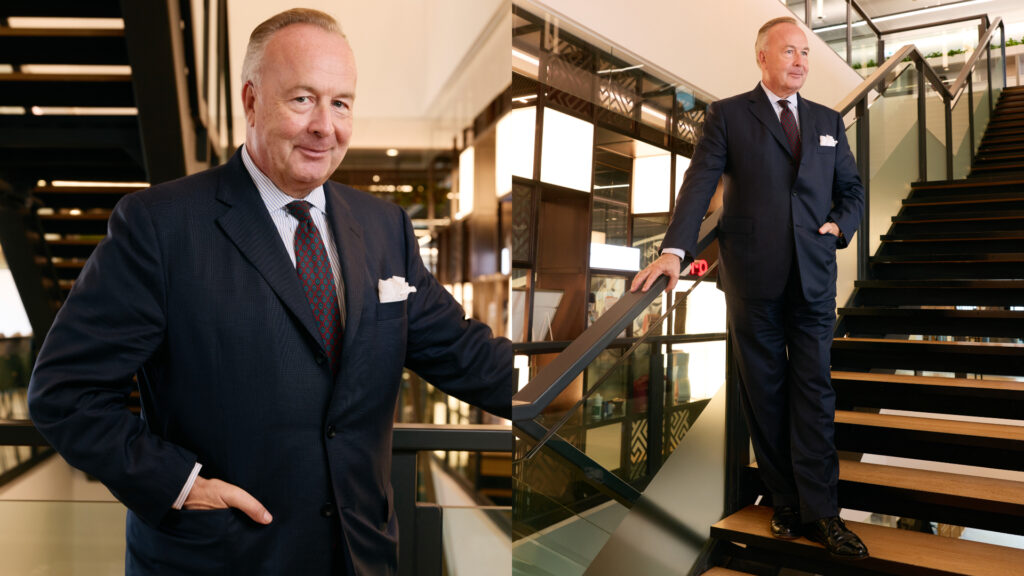

Yim’s long career in architecture began with his interests when he was a child. He says he has been interested in art since he was young. During secondary school, Yim’s father encouraged him to learn about different art forms. But as he grew up, he realised he lacked the qualities of an actual artist. “I think everything I do is not to come up with a permanent solution to things, but architecture can be used to create connections between people,” Yim says. He compares architecture to philosophy: both are ways to solve a problem. “This way of solving issues is practical, but is also an art form,” Yim adds. “Every piece of architecture is grounded in logic and rationale. The way it responds to problems and challenges is actually reflective of an objective purpose. It’s this kind of logic that allows my work to strike a balance between utility and aesthetics.”

Memory Meets Modernity
When discussing Hong Kong’s urban environment, Yim frankly says that much of the city’s early architecture was born out of a need for survival. During that era, housing was focused on functionality and maximising floor area, with little interest in aesthetics or culture. “Our architecture was basically built to fulfill economic needs,” Yim says. “It was only after we met our basic living needs did we start paying attention to urban aesthetics and character.” He says as Hong Kong’s economy gradually took off and material conditions improved, people started to appreciate the beauty and cultural value of architecture. This change made Yim realise that Hong Kong’s architecture should have its own unique language, not just with its exterior design, but with how it embodies the city’s spirit and culture.
Because of this, Yim devoted a lot of time exploring different approaches –– one of which is to incorporate historical elements of the city’s architecture, like pedestrian arcades, village houses and traditional Chinese villages in the New Territories. He has drawn inspiration from these architectural styles to design his projects and add local characters to them, such as youth hostels in country parks that mimic village houses in the New Territories. But Yim admits that traditional methods of building and designing are reaching a dead end in modern society. Building materials and methods of the past no longer suit the demands of the present. As old materials are difficult to repurpose, the emergence of new building material and processes are making it harder for past traditions to survive.
“The insight that tradition gives us is not in its material, it’s in its spirit,” Yim says. “Our traditional means of building can no longer keep up with the rapid growth of our society and economy.” He realises that the city’s architecture must blend tradition and innovation, rather than blindly reviving the past. It’s undeniable that a city like Hong Kong has an incredibly rich history and a diverse cultural background. Architects need to translate those unique elements into design, imbuing every space with historical narratives and sincerity.

Image courtesy of Rocco Design Architects Associates
Functional DNA
Reflecting on his younger days, Yim cannot help but mention the time he represented Hong Kong in a public design competition in 1983 designing the Opéra de la Bastille in Paris. The experience had a profound impact on him. Paris’s architecture is reflective of its urban culture: its winding and narrow streets, outdoor exhibitions and café terraces all inspired elements of his design. “I wove Paris’s urban architectural style into my design, emphasising the relationship architecture has with space and history, which hopefully creates a distinct character for the building,” Yim says. This made him pay attention to how a city’s culture is reflected in its design: its urban landscape, its streets and public spaces, all of which are symbolic representations of the city.
When he returned to Hong Kong, he noticed that the city’s personality combines practicality, flexibility and efficiency, and these traits can be seen in the city’s urban planning. For instance, he mentions a “stacking” strategy –– building upwards to make full use of limited space. Another involves mixing elements with different purposes to create multi-functional spaces. Many of Yim’s projects are a product of integrating different functions. From commercial, residential and public spaces to cultural facilities, he wants to use spaces as flexibly as possible. “We love using hybrid design approaches that allow many elements to exist together,” Yim says. “It offers both convenience and efficiency that is specific to Hong Kong.”
Among Yim’s many projects, the Hong Kong Palace Museum has been a recent focal point. The museum is his modern interpretation of traditional Chinese culture, and serves as a testament to his appreciation for local culture. When he began designing the museum, he knew he wanted the structure to reflect the elegance and understated nature of the ancient imperial Chinese court, while also blending into Hong Kong’s modern skyline. “The museum’s design not only needs to reflect the allure of ancient Chinese architecture, but also allow us to recognise its value to us in today’s society,” Yim states. “This is an embodiment of culture, allowing people to appreciate the exhibitions inside, but also experience the intellect and sophistication of ancient Chinese culture.”
Yim added features of ancient palace architecture to the museum, using subtler shades of gold, red and black to evoke that antique appeal. Because of limited space, Yim cleverly designed multiple levels for the museum, stacking exhibition areas to create a continuous path so that visitors can roam freely, which help spark their curiosity and desire to explore the whole building. This design not only incorporates aspects of traditional architecture, but also provides a modernised experience, allowing the museum to find a balance between heritage and innovation.
The East Kowloon Cultural Centre is also a prime example of connecting the city’s culture. From the outset, the aim was for the building to become a cultural landmark of East Kowloon, and serve to connect the city with its heritage. “We hope that citizens can be exposed to culture in their day-to-day life through architecture and experience the diversity and inclusivity that Hong Kong has to offer,” Yim says. “I’ve integrated many traditional and modern elements to my designs, and layered spaces to create different kinds of experience in every room. There’s a different view and scenery on every level –– the skyline on Hong Kong Island to the south, the natural beauty of Lantau Island to the west –– it’s like another trip to Hong Kong every time you visit.” The project undoubtedly reflects his long-held philosophy: architecture exists to guide the flow of people, to facilitate connection and serve as a symbol of the city’s culture.

Designing For Resonance
As an architect, Yim also serves as an advancer of culture. His book Looking to Hong Kong was published last year, and chronicles his ideas and thoughts on architecture, as well as observations about the city over the years. The book is not just a collection of design notes; it’s a heartfelt love letter to Hong Kong. Yim details the stories behind each project and the emotional threads woven into every design. He hopes readers can recognise the special allure and spirit of Hong Kong. “I want to use this book to help people rediscover Hong Kong,” Yim says. “To see that the city is not just a bunch of busy streets, but a city rich with cultural heritage and compassion.”
When discussing his philosophy in design, Yim stresses that architecture is not just about a building’s exterior, it must also carry emotion and care. “I believe a building’s success is not in its grandiosity, but in its ability to make people feel comfortable, and to resonate with the public,” Yim says. He often walks around the buildings he designed, observing how people interact with the space. Yim jokes that he spends a lot of time at IFC, getting coffee and going on walks. Every time he passes, he could feel the natural flow of people walking through, which is a sure sign of a good design. “That feeling means that I’ve done a good job,” Yim says sincerely.
Looking to the future, Yim hopes to take his experience in Hong Kong and expand to different areas. He believes the sustainable development of the city is not merely a matter of technology, but fundamentally one of culture. Renovation and redevelopment will become big issues for Hong Kong’s future. Many old buildings have safety and health issues, so rebuilding them would be necessary, but we must try to reuse and renovate as much as possible, in line with environmental guidelines. For years, Yim has applied his craftsmanship and wisdom to Hong Kong, building structures that are full of life and warmth. As he said, Yim hopes to tell Hong Kong’s story as best as he can, steadfast in his belief that architecture will always be able to bring a city to new heights and brighter horizons.